

Home / Tools / Infrastructure Decision Frameworks / Asset Intervention Trade-offs
Infrastructure decision framework
Asset Intervention Trade-offs
Compare renewal costs and service loss, then test whether different assumptions about retained equipment would change the choice.
A lower-cost renewal can depend on a fragile assumption
Renewing one part of an asset can leave a fault source in the equipment you retain. Comparing purchase prices alone misses planned outages, future upkeep and the service consequences of that retained condition.
Keep cost, service loss and requirements separate
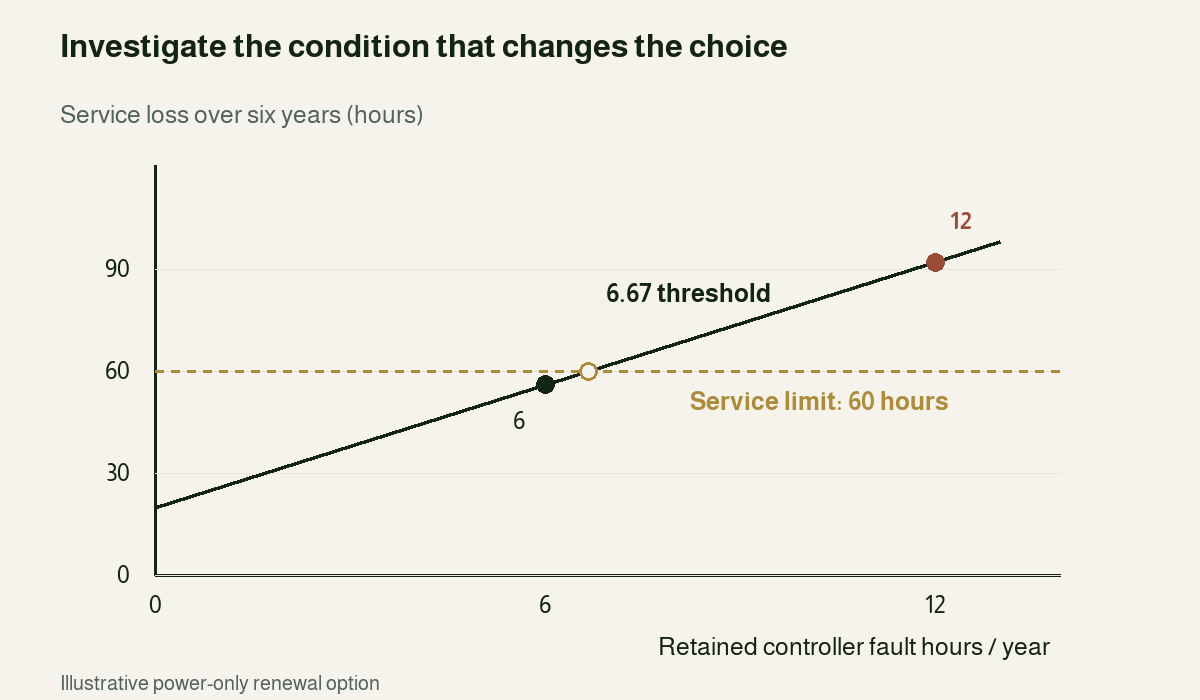
Compare complete options over the same operating period. Put costs on a common discounted basis and count service-loss hours without discounting them. Check mandatory requirements separately. Then find how many hours a year could be lost to faults in retained equipment before the option exceeds the service limit.
Illustrative example.
The power-only option depends on the retained controller
The illustrative control system is required for six more years. Power faults cause 18 service-loss hours a year and controller faults six. Renewing the power supply or renewing both can meet the 60-hour limit.
If the retained-controller forecast increases to 12 fault hours a year, power-only renewal produces 92 service-loss hours and exceeds the limit. Its maintenance cost also needs reassessment. The table compares the four original options, before that change in the forecast.
| Original option | Six-year present cost | Six-year service loss |
|---|---|---|
| Keep both | About AUD 0.811m | 146 hours |
| Renew controller | About AUD 1.506m | 126 hours |
| Renew power | About AUD 1.007m | 56 hours |
| Renew both | About AUD 1.804m | 26 hours |
Build the options around the cause of service loss
Use the comparison for asset improvement and renewal choices where service consequences are sufficiently comparable. Include the work sequence and planned outages. Test credible changes in the condition of equipment you retain, without assigning invented probabilities.
What you bring
Required function, horizon and interruption limits; fault causes and retained-condition evidence; complete intervention scopes and outages; initial, future and residual-value costs; capital, access and mandatory requirements.
What the comparison provides
Present cost, service-loss hours, separate feasibility conditions and the retained-condition threshold that could change the decision.
Service hours do not describe every consequence
An hour at a critical operating time may differ from an hour elsewhere. Keep affected functions, degraded operation, safety and mandatory requirements visible separately. Include later obligations and residual value over the common horizon. Meeting a numerical limit does not establish technical or operating acceptance.
Apply the framework
Compare renewal options and test the assumptions about the equipment you retain.
When another framework helps
Staged Investment and Commitment Pathways
When evidence about retained condition could change the next investment commitment.
Transition Recovery Window
When the intervention must restore service within a fixed operating window.
Discuss your renewal options
Tell us which assets you are considering renewing and what service loss the operation can tolerate.