

Home / Tools / Infrastructure Decision Frameworks / Bid Architecture and Delivery Credibility
Infrastructure decision framework
Bid Architecture and Delivery Credibility
Work out whether the offer covers the full cost of delivery and whether the people you need will be available in time.
A supplier price is only part of the delivery cost
An attractive supplier quote can leave retained integration, assurance and management work uncosted. A team may also have enough people in total while lacking the specialist days needed in a particular period.
Check return and capacity together
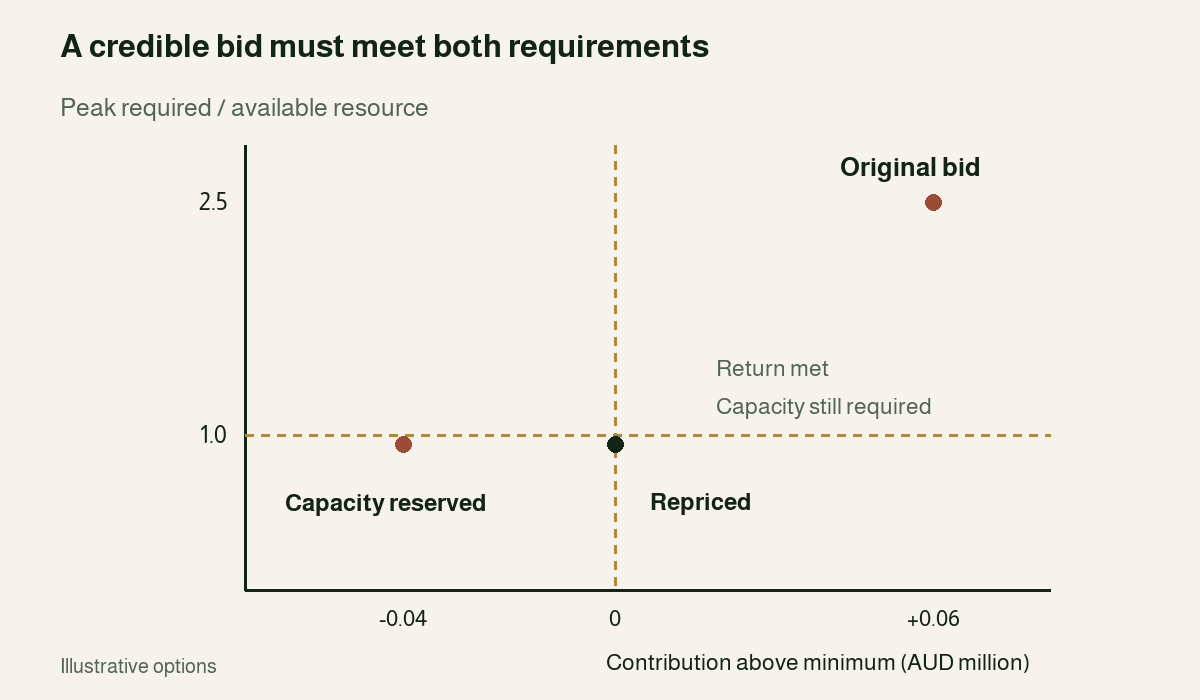
Subtract the complete delivery cost from the proposed price, then compare the contribution with your minimum requirement. Check capacity separately: for each skill and period, divide required days by confirmed available days. The highest ratio identifies the tightest resource constraint. If you change the delivery arrangement, recalculate both cost and capacity.
Illustrative example.
A capacity fix can require a different price
The illustrative AUD 2.40m offer includes AUD 1.80m of supplier work and AUD 0.30m of retained work. Its AUD 0.30m contribution exceeds the AUD 0.24m minimum.
Assurance, however, needs 15 days in weeks 12–13 against six available. Reserving ten extra days costs AUD 0.10m and changes the commercial result.
| Offer arrangement | Complete cost | Above minimum contribution | Highest demand ratio |
|---|---|---|---|
| Original: AUD 2.40m price | AUD 2.10m | +AUD 0.06m | 15 / 6 = 2.50 |
| Reserved capacity: AUD 2.40m price | AUD 2.20m | −AUD 0.04m | 15 / 16 = 0.94 |
| Repriced: AUD 2.44m price | AUD 2.20m | AUD 0 | 15 / 16 = 0.94 |
Connect obligations, cost and confirmed capacity
Use the comparison while developing a bid, responding to procurement or revising scope and price. Divide resource periods finely enough to reveal shortages that a total would hide. Record unresolved client conditions and who is responsible for resolving them.
What you bring
Client obligations and retained work; supplier, internal and indirect costs; price and the approved minimum contribution; required and confirmed available days by skill and period; access and acceptance conditions.
What the comparison provides
Complete delivery cost, amount above minimum contribution, the controlling resource period, unresolved conditions and the next pricing, scope or resource action.
The two axes do not prove deliverability
A ratio of 1.0 uses every available day. Spare days in one skill or period cannot fill another shortage. If assurance availability rises to 20 days, commissioning becomes the tightest constraint: 8 required days against 10 available gives a ratio of 0.80. Check named people, task continuity, dependencies and rework in the delivery plan. A favourable price cannot settle a failed acceptance condition. Apply any percentage contribution policy using its approved definition.
Apply the framework
Build a cost and capacity comparison for the offer you plan to make.
When another framework helps
Delivery System Architecture
When capacity must be tested against the actual sequence, access and release decisions.
Discuss your proposed offer
Tell us what you plan to offer and where the delivery cost or resource commitment is still uncertain.