

Home / Tools / Infrastructure Decision Frameworks / Delivery System Architecture
Infrastructure decision framework
Delivery System Architecture
Identify the work, resources, access and authority controlling your next delivery milestone.
Progress does not always move the delivery date
A supplier can finish its own work while the next milestone still waits for a design release, another party's output or site access. Extra effort brings the date forward only if it changes the dependency holding up that milestone.
Trace the controlling dependency
For each required output, record who supplies it, who needs it and what must be available before the work can proceed. Include resources, site access and release authority. Compare proposed interventions across the complete sequence, then recalculate what controls the finish date.
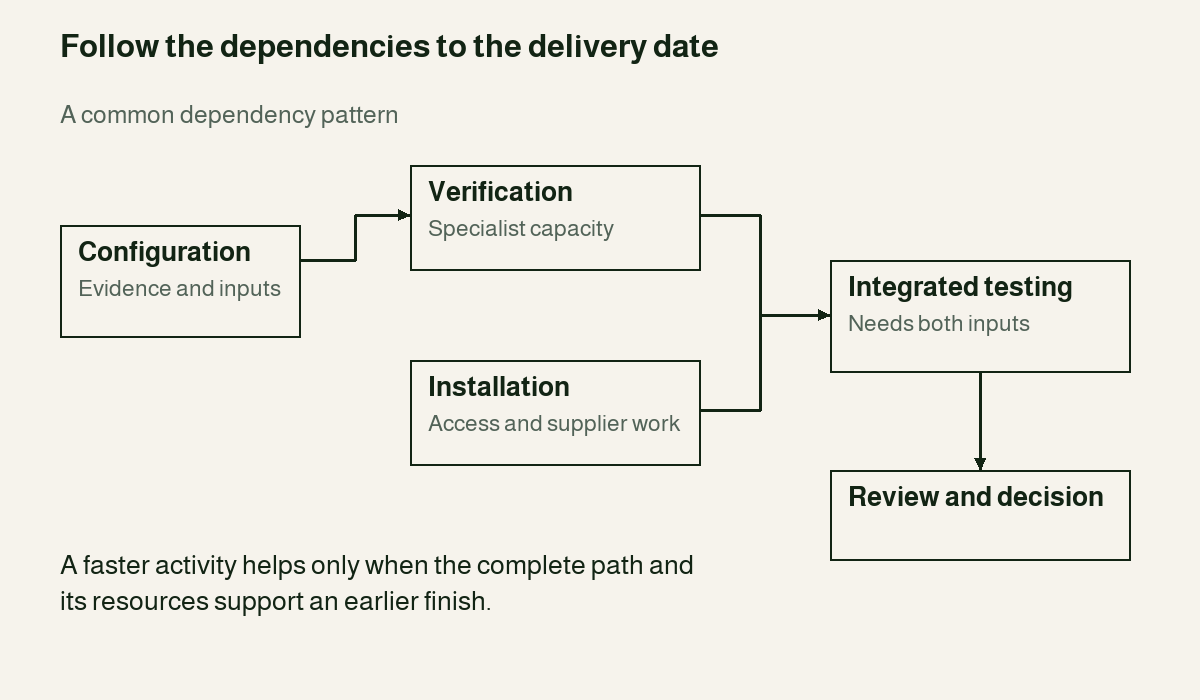
In the illustrated dependency pattern, configuration and specialist capacity support verification. Installation depends on access and supplier work. Verification and installation both feed integrated testing, followed by review and decision.
Illustrative example.
One intervention changes what controls the plan
The illustrative plan targets working day 25 but finishes on day 37. Verification finishes on day 25 and holds up testing, although installation is complete on day 16.
Two integrators and shorter approval waits bring verification to day 14.5. Installation then controls the start of testing, which runs from day 16 to 19. Acceptance review finishes on day 24.
| Arrangement | Forecast finish | Additional cost |
|---|---|---|
| Current | Day 37 | AUD 0 |
| Capacity only | Day 26.5 | AUD 14,600 |
| Authority only | Day 33 | AUD 3,000 |
| Coordinated | Day 24 | AUD 19,400 |
| Later access | Day 28 | AUD 24,200 |
Map your delivery arrangement
Use the method for delivery planning, procurement, design coordination, mobilisation or recovery where several organisations contribute to a milestone. Work back from the required output. Confirm when each party will provide its work, people or access, and who can authorise the necessary releases.
What you bring
Required output and target date; task outputs, owners and prerequisites; fixed durations or effort and productive capacity; access, resource and release dates; intervention costs and supporting evidence.
What the comparison provides
Task start and finish forecasts, the controlling conditions, days against target, unresolved records and the capacity, access and authority commitments required by the chosen intervention.
Check the arrangement in the detailed programme
The example assumes verification and testing effort can be divided between people. Sequential work, equipment limits, coordination overhead and competing demands can change the result. The map does not optimise resources or simulate schedule uncertainty. Keep tasks in prerequisite order, resolve circular dependencies and confirm the result in the detailed schedule. Technical and operating release remains with the named authority.
Apply the framework
Map the dependencies and compare changes that could bring your next milestone within reach.
When another framework helps
Integration Dependency and Evidence Map
When shared configuration, evidence or permission controls an integration route.
Approval Windows and Response Cost
When approval timing and response cost are the decision you need to compare.
Discuss your delivery dependencies
Tell us which milestone you are working towards and what you need from the organisations involved.