

Home / Tools / Infrastructure Decision Frameworks / Integration Dependency and Evidence Map
Infrastructure decision framework
Integration Dependency and Evidence Map
Check what each proposed route needs to deliver the required outcome, and whether its evidence and permissions still apply.
An alternative can share the same unresolved condition
Two ways to provide a service may depend on the same configuration, people or evidence. When that shared condition changes, switching routes may leave the underlying gap unresolved. A successful earlier test also needs to remain applicable to the configuration now proposed.
Connect every route to its conditions
Record what must be true for each route to deliver the required outcome. Link those claims to their dependencies, supporting evidence and current permission. Show shared conditions wherever they affect more than one route. Keep missing, contradicted and outdated evidence distinct so you can identify the next test, repair or review.
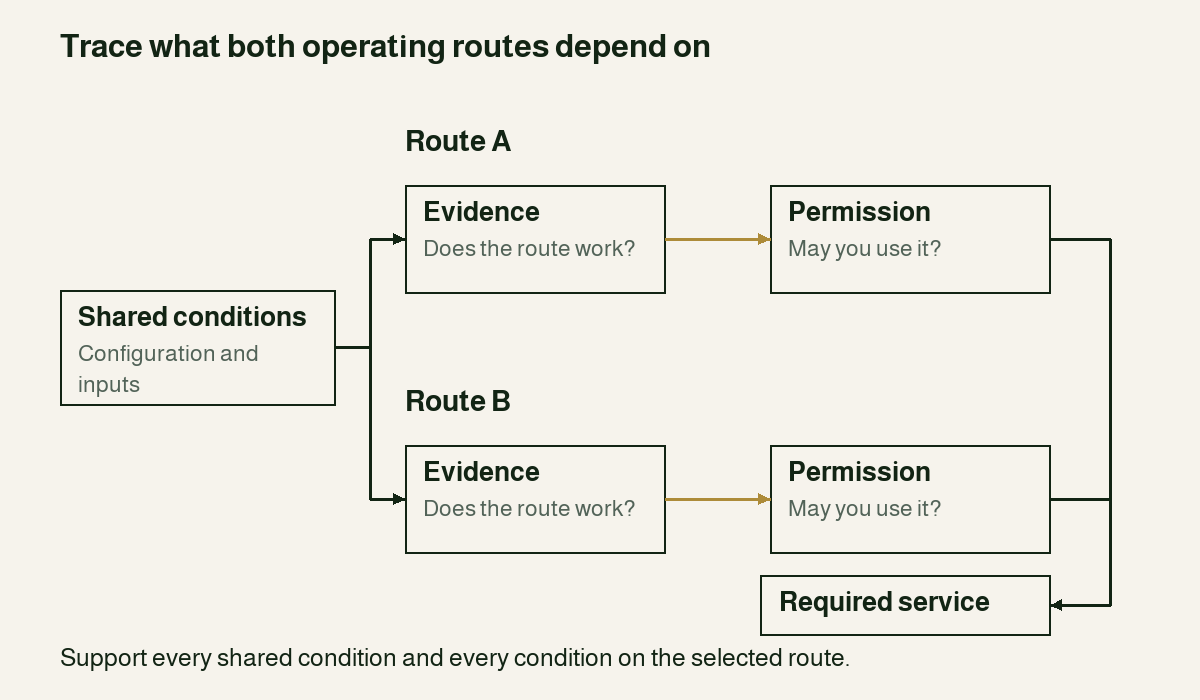
Illustrative example.
A shared change requires both routes to be reassessed
The illustrative upgrade must alert a duty operator within 60 seconds of a critical alarm. A remote alarm and a staffed local console each have supporting checks for the installed configuration.
A later software change alters alarm priorities. The earlier results remain part of the record, but their applicability to the new configuration must be checked before either route can be relied on.
| Changed condition | Routes affected | Next action |
|---|---|---|
| Remote communications result fails | Remote alarm route | Repair and retest that route |
| Local drill remains current | Staffed console retains evidence support | Check staffing and current permission |
| Shared alarm configuration changes | Both routes | Review affected claims, evidence and permission scope |
Make the basis of the decision traceable
Use the map during requirements and design coordination, integration planning, testing or an operating change. Record each conditional requirement and the trigger that makes it applicable. Reassess all linked routes when a shared input changes.
What you bring
Required performance, configuration and period; route dependencies; claims and evidence with applicability; permission scope, authority and status; unresolved conditions and accountable owners.
What the comparison provides
The conditions supporting each route, shared gaps, affected claims after a change and the tests, repairs, reviews or permissions needed next.
A supported route still requires the proper decisions
Evidence must be assessed for the intended configuration and operating conditions. A route count does not establish independence or reliability. The map does not perform safety analysis or evaluate every failure combination and degraded mode. Technical evidence cannot substitute for permission, and the map does not authorise operation.
Apply the framework
Map the conditions, evidence and permissions supporting each complete operating option.
When another framework helps
Delivery System Architecture
When the unresolved work needs a delivery sequence, resources and release commitments.
Transition Recovery Window
When the next change may remove a recovery option within a fixed service window.
Discuss your dependencies and evidence
Tell us which outcome you need to support and what has changed in the proposed configuration or operating conditions.