

Home / Tools / Infrastructure Decision Frameworks / Approval Windows and Response Cost
Infrastructure decision framework
Approval Windows and Response Cost
Identify which approval controls a response and whether accelerating it changes the cost.
Faster approval helps only when it changes the start
A response may need financial, technical and access decisions before work can begin. Delegating one approval can add cost without saving time if another required decision still controls the start.
Work back from the required operating date
Work back from the required operating date: subtract execution time to find the latest approval date. For each route, use the latest forecast date among all approvals needed before work can start. Calculate the resulting finish date and the delay expenditure that an earlier finish could avoid, then include the cost of the route. Keep actual authority, funding, notices and contractual recovery separate from these forecasts.
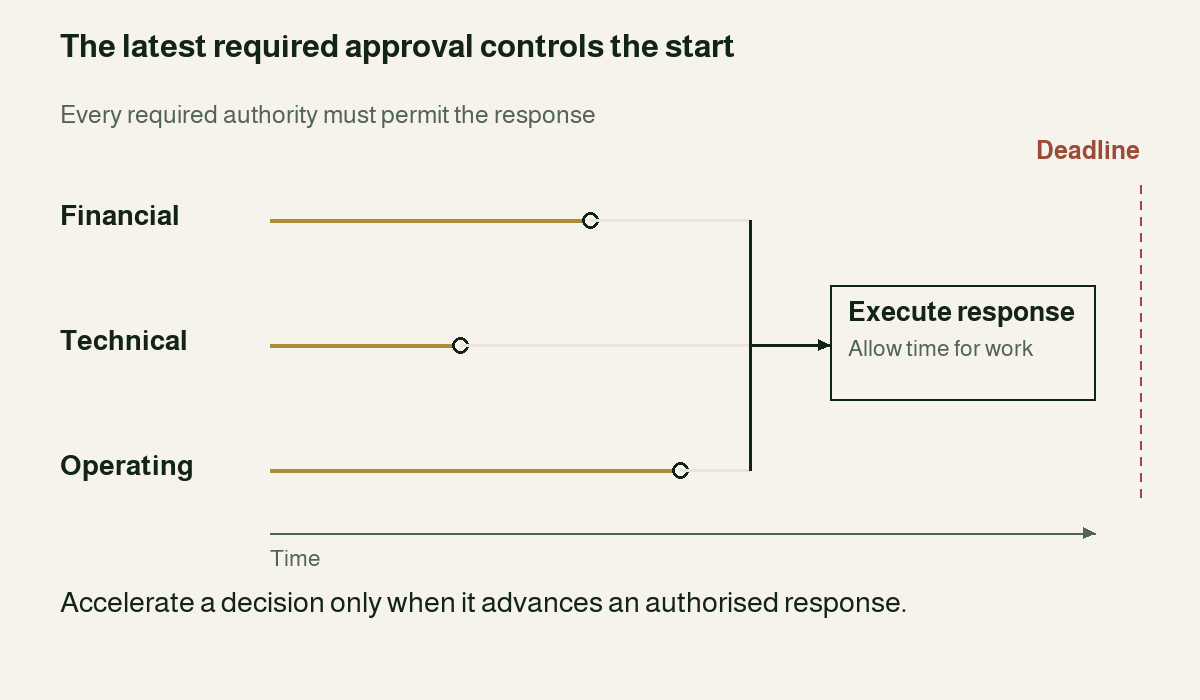
Illustrative example.
A later technical decision removes the delegation saving
The illustrative defect needs two days of work before operation on day 6. Day 4 is the latest approval and response-start date that meets that deadline. Technical approval is initially forecast for day 3.
Delegating financial authority moves its forecast from day 7 to day 3 and reduces forecast expenditure by AUD 48,000. If technical approval later moves to day 8, both financial routes must wait for it. Delegation then adds AUD 6,000 without advancing completion.
| Approval arrangement | Response finish | Forecast expenditure |
|---|---|---|
| Standard finance day 7, technical day 3 | Day 9 | AUD 126,000 |
| Delegated finance day 3, technical day 3 | Day 5 | AUD 78,000 |
| Standard finance day 7, technical day 8 | Day 10 | AUD 144,000 |
| Delegated finance day 3, technical day 8 | Day 10 | AUD 150,000 |
Compare the complete approval path
Use the method when approval timing affects a corrective response, change or delivery commitment. Identify who makes each decision and what information they need. Check whether bringing that decision forward would let the work start or finish sooner.
What you bring
Required response and operating date; execution duration; every required approval, forecast, owner and scope; base, incremental delay and route costs; funding, notices and evidence of authority.
What the comparison provides
Latest approval date, controlling approval, forecast start and finish, delay and total response expenditure, with actual authority and contractual questions recorded separately.
A forecast is not authority or entitlement
Confirm approval availability dates and include their dependencies. The comparison does not schedule a complex approval process or determine liability and contractual recovery. Refused or unresolved authority cannot support a firm response. Count only delay costs that an earlier finish could avoid, and count each consequence once.
Apply the framework
Compare approval dates, execution time and response costs to identify which decision needs attention.
When another framework helps
Delivery System Architecture
When execution spans several parties, tasks or resource commitments.
Integration Dependency and Evidence Map
When configuration, evidence or permission is the unresolved basis for the decision.
Discuss the approval controlling your response
Tell us which response needs approval, when the work must finish and what a delay could cost.